
Mailing List
Sign up for our mailing list to get latest updates and offers.
The ancient history of the Maldives is a mixture of fact and legend. The Maldives history has been shaped and moulded with the ebb and flow of time and tide.
Throughout ancient times, the Maldives has been influenced by the major civilisations of the world. The Phoenicians, Egyptians and Mesopotamians have passed through the islands during ancient times, each imprinting their influence upon them.
The famous cowry shell from the Maldives once used as currency in different parts of the world has been found in the ruins of the ancient Indus Valley port of Lothal, dating back to 1400 BC. Norwegian adventurer, Thor Heyerdahl the famous archaeologist writes that the Maldives was first settled by sun-worshipping seafarers known as ‘Redhin’, as early as 2500 BC, before Buddhism and later Islam changed the religious landscape of the country.
The Maldives was invaded by Portuguese in 1558 and ruled by them until 1573, continuously raided by Malabars from South West India during the 17TH and 18TH centuries and eventually invaded by them in 1752. Although the Malabar rule was short-lived the raids continued. The Sultans sought protection first from the French at first and then in 1887 signed a protectorate agreement with the British.
Historical records of the Maldives have been found all over the world from Rome to China, in memoirs of Arab and French travellers and as early as the first century AD. In addition to the content of the record, the records themselves help us to fathom the historical links we have had with people and countries the world over.
Ancient chronicles of South India and the Mahavansa of Sri Lanka contain records about the Maldives. Records on the Mahavansa, one of the ships that sailed with Prince Vijaya who went to Sri Lanka in 500 BC, went adrift and landed at an island called Mahiladvipika, which is the Maldives.
A Roman manual of navigation from the first century AD, Periplus Maris Erithraei mentions islands assumed to be the Maldives.
Ptolemy, the famous 2ND century AD Greek astronomer, mathematician and geographer, refers to the Maldives in his Geography.
The first record of Maldivians sailing abroad is obtained from the writings of the Roman soldier and historian Amianus Marcelinus (circa 320-390 AD). He records a visit by a delegation of Divis (Maldivians) to Rome in 362 AD bearing gifts to Emperor Julian.
A historical document of China records that in the years 658 AD and 662 AD, the King of the Maldives sent gifts to the Chinese Emperor Kao-Tsung of the Tang dynasty. The gifts were taken to his court by Maldivians.
According to written records of the Chola Dynasty of South India, the Chola king Raja Raja I (985-1014 AD) captured a number of islands of the Maldives after a naval encounter during the late 10TH or 11TH century AD.
Arab travellers wrote about the Maldives as early as the 900 AD. In 1343 AD Ibn Batuta the famous historian and traveller visited the Maldives, lived here and wrote about the country.
The famous French traveller, Francois Pyrard de Laval, arrived in the Maldives with his ship "Corbin" in the year 1602 AD, during the reign of Kalaafaanu. The writings of Pyrard relate a number of stories and events in the Maldives during that time.
1901: Second scientific expedition to Maldives led by Alexander Agassiz.
1902: King Imadudeen VI leaves Maldives for Egypt to marry the daughter of the Persian (Iranian) consul in Egypt.
1905: Official British visit to Male' for the 'Assumption of the State Sword' ceremony of King Shamsudeen.
1906: Opening of the first post office and regular mail service.
1909: British governor of Ceylon makes official visit to Male'.
1914: At start of war, imported food and other goods increase suddenly in price. Trade in the capital is controlled by Borahs, Indian nationals resident in Male'. Government in Male' sends grain to atolls to alleviate the food shortages.
1917: British military seaplane wrecked near Filitheyo island on Faafu atoll. Pilots rescued by fishing boats from Fieeali and Bileiydhoo islands.
1920: British present King Shamsudeen with the 'Warrant and Insignia of Most Distinguished Order of Saint Michael and Saint George'. Formal presentation ceremony in Male'.
1922: H.C.P. Bell examine Buddhist remains in Gan island, and an old coral rock fort on Hithadhoo.
1928: Government school Madharusathul-Saniyya opens in Male' and now known as Majeedhiyya School.
1930: Japanese survey ship visits Maldives and cruises around the atolls for months.
1931: Population of Maldives is around 80,000.
1932: The 81st Monarch Sultan Mohamed Shamsudeen III proclaims Maldives' first written constitution.
1934: Second constitution proclaimed. It is based on the first 1932 constitution with amendments.
1935: King Hassan Nooradeen is chosen to be king with ceremonial powers only.
1936: Third constitution proclaimed with more amendments.
1940: Rice rationed in Maldives by Hassan Fareed - one cup per person in Male', half cup per person in other islands.
1941: British Royal marines land on Addu atoll to establish secret Port T base.
1942: Royal Marine Engineers arrive on Addu and construct airport on Gan island.
1943: Mohamed Amin assumes power. The National Security Service is set up and fish exports are nationalised.
1947: British give 300,000 pounds sterling. Money is compensation from the Japanese for the families of the victims of the sinking of the Addu ship Yahunbarahu during WW2.
1948: The Maldives saw the issuance of the country’s first legal tender notes.
1950: A passport office was established to issue travel documents.
1952: Electricity available in Male'.
1953: The First Republic was proclaimed with Muhammed Amin as its president but was overthrown in August.
1954: Sultan Muhammed Fareed al Awwal ascended the throne of the Sultanate.
1956: Municipal council formed.
1957: Ibrahim Nasir is elected president. His call for a review of the British occupation of Gan Island leads to three southern atolls temporarily breaking away to form a separate state called United Suvadive Islands.
1958: Roman calendar date system adopted from 1 January.
1960: Hulhule' airport construction begins. Maldives grants the British a 30 year lease of Gan.
1962: Huvadhu atoll divided in half for administration. The break-away atolls become part of the Maldives again.
1963: British agree to return Addu to Male' control.
1964: Women permitted to vote in Maldives. Girl Guides established.
1965: July 26, Maldives attain full independence from the British. Became a member of the United Nations on September 21.
1966: Hulhule airport opens and Air Ceylon flight makes first commercial landing.
1967: The Government hospital is opened with British assistance. Renamed the Central hospital (now known as ADK Hospital). Maldives joins International Telecommunications, International Maritime Organisation, Universal Postal Union.
1968: The Majlis votes in favor of setting up a republic which was then confirmed by a public referendum. Ibrahim Nasir elected as President of the Republic and sworn in on 11 November.
1972: On 16 February the first group of 22 Italian tourists visits the Maldives; 1097 tourists arrive in the year. British queen Elizabeth II visits Maldives.
1974: State Bank of India opens branch in Male'. First bank in Maldives.
1976: British decide to abandon Gan base on Addu atoll, 10 years before their lease expires. State Trading Organisation, STO, established.
1977: Wireless communication, organised by Cable and Wireless, begins from Male'. Enables direct communication between Nasir and Maldives representatives in UN.
1978: Felivaru fish canning factory opened in February as joint venture with Japanese Nippon corporation. Television broadcasts begin in March. Ibrahim Nasir retires on 10 November after completing two terms of office as president. Maumoon Abdul Gayyoom elected as president.
1979: First government primary schools outside Male' opened in Manadhoo island Noonu atoll and Kulhudhuffushi, Haa Dhaal atoll.
1980: Basic Education Project begins in Male'. Later, UNICEF and UNDP fund Atoll Education Centre.
1981: Male’ International Airport is opened. Maldives Monetary Authority established.
1982: Science Education Centre, funded by the UNDP, opens in Male'.
1983: The Maldives is made a special member of the Commonwealth of Nations.
1984: Islamic Centre and Grand Friday mosque, designed by Malaysian architects, opened in Male'. Wood carvings and Arabic calligraphy done by Maldivians.
1987: High waves devastated parts of Male’ and several other islands. Surfacing of roads begins in Male'. International direct dialing services begin in Maldives. Population of Maldives reaches 200,000.
1988: Sri Lankan mercenaries attempt to overthrow the government, apprehended with the help of the Indian military.
1989: National environment action plan developed.
1990: The Maldives celebrates 25 years of independence. Breakwater on south side of Male’ is completed.
1992: Maldives participates in Earth Summit at Rio de Janerio.
1995: Survey carried out on marine protected site on Ari atoll.
1996: Tobacco advertising banned throughout Maldives.
1997: Reclamation of Hulhumale begin to accommodate a growing population of Male'.
1998: Tourism is further expanded with 14 new resorts.
Evidence suggests that Maldives has been populated and thriving as early as the 4TH century BC. It is evident that the first settlers were an Indo Aryan race from India and historical records show that although small in numbers, people have migrated from Arabia and eastern Africa.
An anthropological survey carried out at the end of the 19TH century showed the Maldivian inhabitants had traits that revealed ancestral linkages with peoples from all corners of the Indian Ocean. Today, the Maldivians are a mixed race with a population of about 550,000.
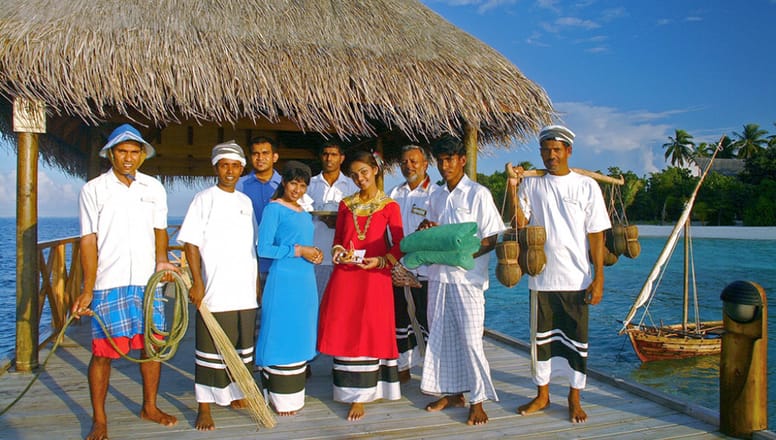
Travellers to the Maldives have commented on the Maldivian people as kind and hospitable people, a peaceable race and as a people who are kind to visitors and travellers.
The people of the Maldives are unified by a common history, faith and language. Although the islands are dispersed over a long stretch of ocean, these elements create a common bond that has kept the Maldives unified as a nation for centuries.
© 2022 Horizon Trip Maldives. All rights reserved
Developed & Maintenance By Davolt
